Posts tonen met het label transition. Alle posts tonen

zondag 13 januari 2013

the shadow that seems to have a life of its own


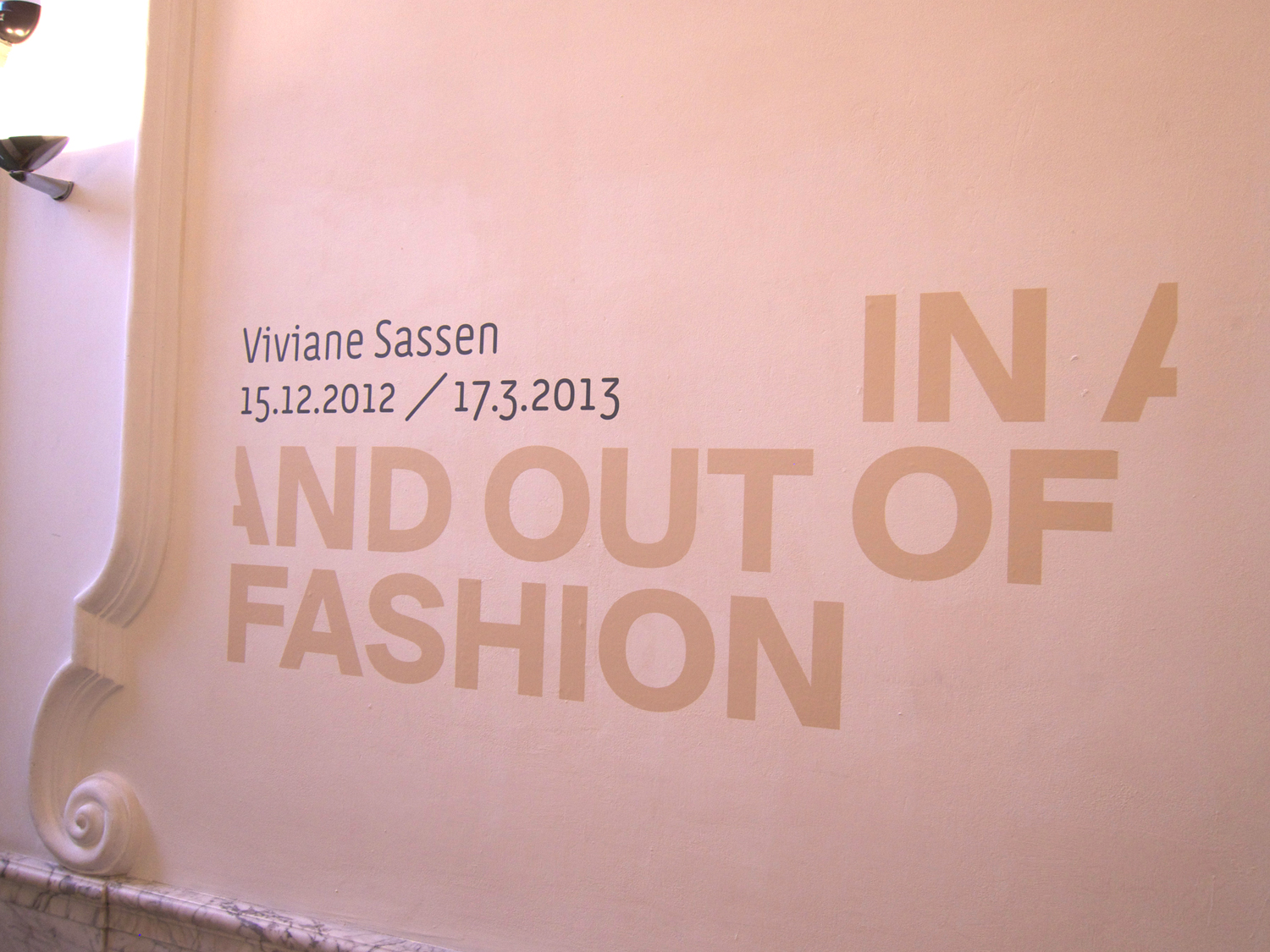
Today I visited 'In and out of fashion' an exhibition in the Photography Museum 'Huis Marseille' to see some fascinating images of the Dutch photographer Viviane Sassen.

Although there are some clearly distinguishable leitmotivs in her work, the images of Viviane Sassen are far from obvious. Strange sometimes surrealistic visual stories are created with shadows that seem to have a life of its own. Colorful images of complex collage like compositions in which it is not clear what body part belongs to which person or how many persons do occupy the image.   
By introducing a partly concealed second model or by merging two persons into one a feeling of alienation is created in a very subtle way.
It takes a while to understand what you are looking at.

In the cellar of the building a little insight in the process is given. Looking at the sketch books and listening to an interview it becomes clear that the work is very conscientiously constructed. In simple line drawings the starting point for some final works that are exhibited upstairs can be recognized. 


In another space the exhibition is made more dynamic, moving images are projected on a mirror wall that subsequently reflects the images on an opposite separate panel in the room and on the wall. The complexity of this set up seem to refer to the photo sessions in which also mirrors are used. On an adjacent big screen an endless row of images moves in reasonably rapid tempo from left to right. It is impossible to stop watching, each image grabs your attention and makes you eager to see whats next.


vrijdag 30 november 2012

A shift in perspective

On Sunday, the day after the Designers Saturday event, I decide to take the bus to Weil am Rhein for a visit to the famous Vitra-House. On this rainy early morning crossing the border with Germany driving through some deserted little villages makes me wonder where this trip will lead me to, whether I am really heading in the right direction. But once arrived at the Vitra premises witnessing this spatial wonder placed in the middle of vast green meadows an instant feeling of excitement takes over.

The building, designed by the Swiss architects Herzog and deMeuron, is a construction of stacked and cantilevered building blocks that in shape refer to the archetypical representation of a house. This architectural assemblage has a certain degree of complexity and when entering the building it becomes even more disorientating. The stacked volumes are blending into geometrically complex shapes which are connected by staircases that do not necessarily respect the logic of the separate building blocks.

Wandering through this Vitra labyrinth is wonderful, the unexpected points of view that are offered do remind me of the sculptural building transformations of the 70ties artist Gordon Matta-Clark. His tube shaped intersections that carved in an 45 degree angle through the various levels of an abandoned building created a complete new spatial experience.

An other more recent example in this context is the infrastructure of the buildings of  the Japanese architect Sou Fujimoto. One of his projects, The Musashino Art University Library, has a labyrinth like interior with walls that are composed from bookshelves spiraling in from the perimeter and providing views and access across the different spaces via cutouts.

Although the interior of the Vitra-House in itself offers an unique experience but surprisingly enough it doesn't distract the attention from what is exhibited in it. There seems to be a natural balance between a space with a genuine outspoken identity and a perfectly styled collection of great furniture.
Vitra House

Interior view Vitra House
The Musashino Art University Library by the Japanese architect Sou Fujimoto.
transformed buildings by Gordon Matta-Clark
House N by Japanese architect Sou Fujimoto

transformed buildings by Gordon Matta-Clark
Photograph of Vitra furniture


maandag 16 april 2012

Flexible framework


Das House 2012


The project "Das House" presented by the designers Nipa Doshi and Jonathan Levien,  during the  "Imm Cologne" fair in January, offers a good scenario of  how to make an existing framework more flexible, more dynamic, creating space for improvisation.

Quote “Das Haus is about domestic activity and redefining traditional spaces, structuring the house into functional zones and challenging cliché notions of what is a bedroom, kitchen or bathroom. Every part of the house connects and redefines, intersecting volumes of the kind you might find in industrial buildings to create fragmented spaces. Walls with varying degrees of transparency and frames with mesh-like coverings. A microcosm in which all the spaces are interconnected”

http://www.doshilevien.com/projects/installations


woensdag 11 april 2012

Capture the moment


More and more designers are challenged by the process, material properties or artisinal skills. 
Tim Simpson and Sarah van Gameren from studio Glithero focus in their work on the transition of an object during the production process. Their leitmotif is  “To capture and present the beauty in the moment things are” This quest is superseding the importance of the finished product, they create experiences, the end product becomes the medium, the process the message.

 'A brief moment of happiness' which is being developed in support of the Vauxhall Collective, is a collection of ceramic objects whose decorative surfaces have been captured through the process of blueprinting.


http://www.glithero.com/

Transition

A never ending story

Transition is about the dynamics of change.
There is a growing awareness (uneasyness?) of the increasingly speed in which information is updated and in which things evolve. The  fast expanding amount of available choices results in a need to get more grip. 

There seems to be a connection with the emerging attention for mindfulness courses where the focus is on the experience of the moment, the transition, promoting to exchange our western pro-active approach for a more Asian “being” or “laissé faire” attitude.

In the design world there is a fascination for the ephemeral and the temporal elements of a process, this mentality can be found in projects where the focus is on trying to capture and to archieve the process, to visualize the history of the process within the product itself. A shifting attention from the end result to everything that happens before, visualising the neglected moments. It is a reflective, philisophical approach, slightly linked to the art world.