maandag 11 februari 2013

seeing is believing

The Believer is omnipresent. Not in a religious sense, as churches are gradually fading out of our society. But as somebody who believes in his own cause, making his own choices, setting his own goals, not distracted by expectations set by the outside world. The Believer is on a mission and creates his own truth. Driven by enthusiasm, faith and passion he is an amateur in the true sense of the word (from the Latin 'amator', 'lover'). The point of view of The Believer is unique and his intense focus disconnects his work from existing conventions. His belief is his life and sometimes they make a living doing it,but they really don't care if you call them professionals or hobbyists. They just do it.

They've always been around, but new media make their fascination easily visible. Sometimes a Believer gets picked up by a curator, as was the case with The Museum of Everything. 
http://www.museumofeverything.com/

Dutch designer Christien Meindertsma puts the modest Loes Veenstra in the limelight by archiving and exhibiting her lifelong passion for knitting random sweaters.
The collected knittings of Loes Veenstra, cover and content
Bill Cunningham does only one thing: whenever he gets up, he takes his camera and his bikes on the streets of NYC and starts looking at the way people dress. He has a sharp eye and the ultimate embarrassment is "when you pass him & he doesn't take your picture". says Anna Wintour. He publishes in the NewYork Times and his observations are as educational as amusing. 
This week fashion is out of fashion, because it's New York Fashion Week. 
1984 Bill Cunningham, photo by Arthur Elgort
Also don't forget to watch the documentary about this heartwarming and inspiring man: http://youtu.be/NYqiLJBXbss


maandag 28 januari 2013

Our Lord in the Attic


Early Saturday morning and although its cold and weekend I decide nevertheless to visit the Winter Salon. This Art Fashion and Design event is spread over various unique locations in Amsterdam and organized twice a year. The kick off is at Our Lord in the Attic, a hidden Catholic church built during the Reformation in the 17th century. The church is nearly empty, the tourists are probably outside searching for the church that doesn't look like a church.

The experience of this holy space with its beautiful colors and rich materials is quite exceptional and the exhibited contemporary expressions blend in surprisingly well. The interior has just been renovated and some traces of historical research are still visible. Funny how my judgement of the presented works seems to be influenced by the atmosphere of this hidden sanctuary. A bit blurred.

Outside some first snow flakes swirl down in slow motion, inside its warm and safe. I think I 'll stay just a little bit longer.

Louise te Poele City Bird
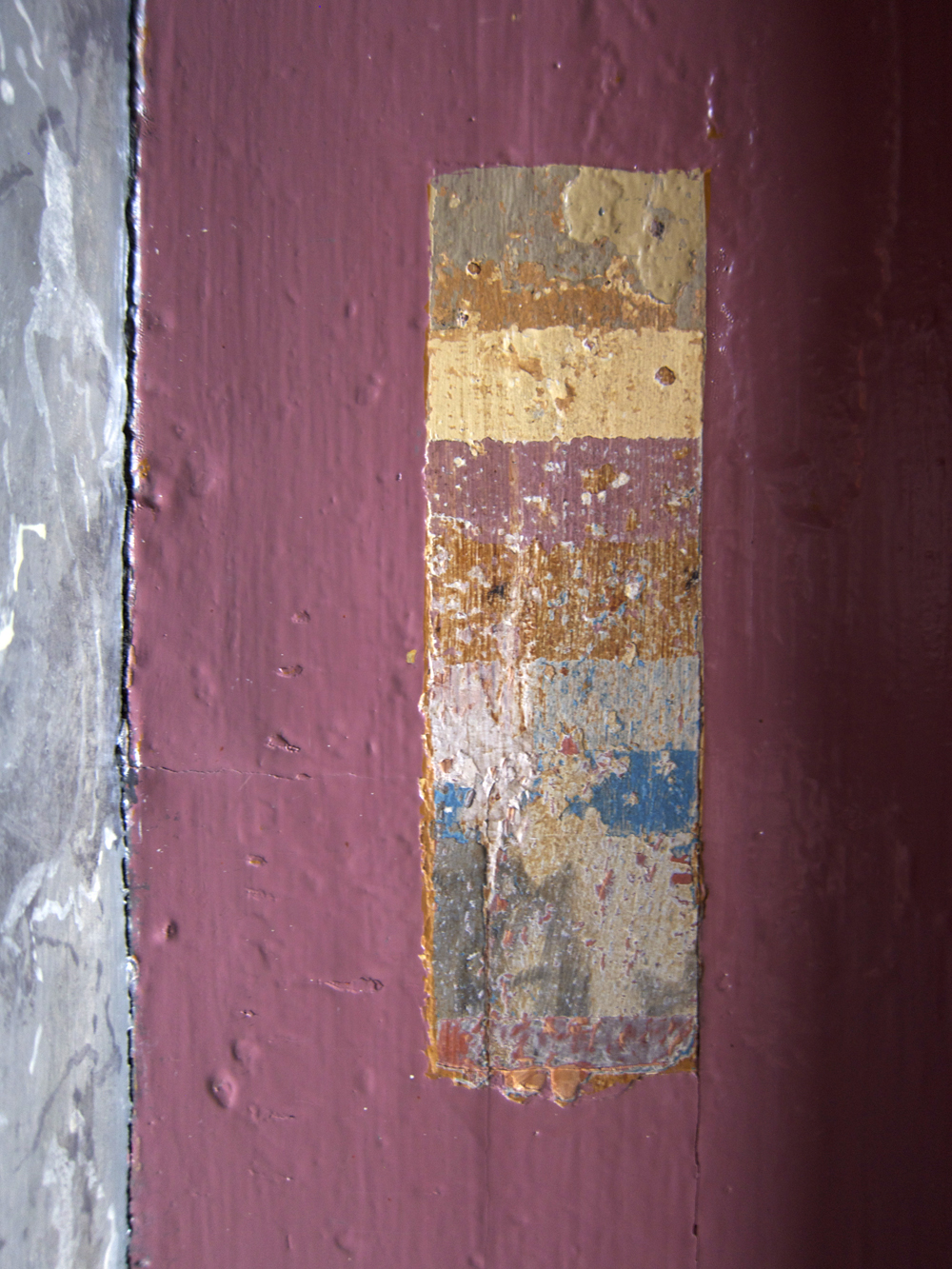
Traces of restauration research
wallpaper
Ceramic tiles floor pattern
FredFarrowBrittAvelontan
After I leave the church the weather is becoming more and more dramatic. The rest of the day is a constant search for shelter and hope for a reliving of the Our Lord in the Attic experience. Each time I enter the next historic highlight I feel a relief, friendly people, nice environment, but the presentations are often disappointing. Luckily there are some exceptions that makes this quest worthwhile.

Museum Geelvinck pantry, low storage room above the dining room
Museum Geelvinck, Sara Vrugt
Museum 'Het Grachtenhuis' Vroonland and Vaandrager
Museum 'Het Grachtenhuis' Borre Akkersdijk en Friso Dijkstra
Museum Het Grachtenhuis, Desiree Hammen "Cherish"


zondag 20 januari 2013

The museum of everything


14, Boulevard Raspail, Paris
Walking on the Boulevard Raspail I notice a sign positioned above an alley that draws my attention. Although I had decided to spend my time in Paris as efficiently as possible I somehow can't ignore this elegantly black and red hand painted sign with the mysterious title: 'The museum of everything'...

a trail of anonymous names
Once entering the alley there is no way back. The walls are covered with strains of unfamiliar names in hand written typography, it invites me to go deeper into tunnel. Halfway the alley a young man sitting inside a little red and white striped cubicle is selling tickets, now it really starts to feel as if I have walked into a performance. Some small talk with the man learns me that this is not a regular museum, this is a place where work of some 200 autodidactic artist is presented. It sounds crazy enough to me to decide to go with the flow and to buy a ticket.
ticket vending box
The alley leeds me to a spacious 'cour' with a hugh building in it, a former catholic boarding school for girls as I am explained later. The big arrow in the 'cour' leaves no doubt where to head to. I climb the two storeys high external metal staircase and when I finally enter the space I am overwhelmed. Overwhelmed by the intensity and the density of the exhibited work, the whole place is packed with paintings, small installations, photographs, textile art: you name it and it's there.
la cour
signs for everything
Next to each work hangs a sign with a description of personal details connecting the peculiar fascinations of the artist with the exposed work. Sometimes it describes drama in a nutshell, sometimes it's really crazy but often it's touching. These little stories can concern anybody, they read like a compact representation of daily life flirting with the crazy side of it.


It is not allowed to take pictures of the exhibited work, warnings of a 1000 euro fine for the sinner are clearly taken seriously by the visitors. Luckily the attendant gives me permission to take photographs of the text, which to me is as important as the work itself. The same woman also explains me more about the story behind the exhibition that is originally coming from London. The British curator James Brett initiated the concept of the Museum of Everything with work of the 'self made man' that is 'living outside society'. Le nouveau 'Art Brut' as she explains to me.

Whatever it's called and however it's labelled it is a fascinating and convincing exhibition. You can easily wander around for hours in this hugh unpolished art space absorbing the stories. Unfortunately the exhibition will be finished soon and as I understood the building will be torn down in the near future. A pity, the rawness of this space feels like the perfect context for these captured emotions.


zondag 13 januari 2013

the shadow that seems to have a life of its own


Today I visited 'In and out of fashion' an exhibition in the Photography Museum 'Huis Marseille' to see some fascinating images of the Dutch photographer Viviane Sassen.

Although there are some clearly distinguishable leitmotivs in her work, the images of Viviane Sassen are far from obvious. Strange sometimes surrealistic visual stories are created with shadows that seem to have a life of its own. Colorful images of complex collage like compositions in which it is not clear what body part belongs to which person or how many persons do occupy the image.   
By introducing a partly concealed second model or by merging two persons into one a feeling of alienation is created in a very subtle way.
It takes a while to understand what you are looking at.

In the cellar of the building a little insight in the process is given. Looking at the sketch books and listening to an interview it becomes clear that the work is very conscientiously constructed. In simple line drawings the starting point for some final works that are exhibited upstairs can be recognized. 


In another space the exhibition is made more dynamic, moving images are projected on a mirror wall that subsequently reflects the images on an opposite separate panel in the room and on the wall. The complexity of this set up seem to refer to the photo sessions in which also mirrors are used. On an adjacent big screen an endless row of images moves in reasonably rapid tempo from left to right. It is impossible to stop watching, each image grabs your attention and makes you eager to see whats next.


donderdag 27 december 2012

the biggest Dutch Design library in Yangon

Dau Dai Zum Zang
On Sunday morning at 7 o'clock our friend Dau Dai Zum Zang arrives at Schiphol, it is his first trip outside his homeland Myanmar. Although it is 8 degrees that day, a reasonably mild temperature for this time of year, for Dau Dai it is extremely cold, an experience that, as he explained us later, he can't describe in words to his girlfriend back home. The first thing he does that day, is go into town and buy the heaviest wool sweater he can find. 

Dau Dai travels to the Netherlands on invitation of the Premsela Organization, the Netherlands institute for Design and Fashion and is asked to take part in a program on Design & Political activism. As an English speaking young graphic designer living in Yangon, eager to learn, open minded and seriously aware of his the role of connector and of his responsibility towards his colleagues in Yangon, Dau Dai is a perfect choice. 

Premsela has organized an extensive five day program of meetings with top of the bill designers, with visits to museums and galleries. There are also with some exclusive events, such as a meeting with the Mayor of Amsterdam who organizes a reception in honour of the 2012 Prince Claus Awards at his official residence. He also has been invited to a reception by the queen. And for this occasion Dau Dai is wearing his traditional Burmese outfit. 

We don't see our friend very often that week, his program is extremely dense with hardly any spare time left. Luckily he has some days left after the program. We invite him to stay at our place.  Dau Dai goes to the Albert Cuyp market, afterwards he expresses his sincere surprise about the fact that white people are actually working, being only used to meet white people who can afford to travel to his country and stay at expensive hotels. At night he posted a picture on Facebook of a lonely seagull outside his hotel. His comment: "The bird is very fat."

The day before Dau Dai returned to Yangon we make a trip to Eindhoven, to the Design Academy. On invitation we may witness that afternoon what happens during a graduation at the Design Academy. We can experience the atmosphere and have a sneak preview of the presented projects with some exclusive presentations by the students themselves. 

Two students from two different departments present to us in an informal lightweight manner their joint project. There seems to be a nice parallel between the chemistry of the two students and the presented research on the combining of earthenware with porcelain in one object. Interesting to see how research comes to life when it is presented in an aesthetic way, when the visual appearance support the story, when the story connects well with the person who presents it, and when the story makes sense. Logic and poetry together definitely works well!
  
During the introduction one of our guides explains to Dau Dai about the points of view of the Design Academy about the emphasis in the first academic year on creating a design mentality before focussing on the actual design process. Using mentality as a fundament, responding to the fact that the role of the designer of today is broad and can be developed in any direction; Advisor, reviewer, builder, connector, researcher, storyteller are just a few examples. Mentality building also as response to the need for a flexible approach as designer. An example mentioned is the rapid development of the 3D printing process, it raises the question whether design is still the exclusive domain of the designer, what can are the new demands in this context?

We end up having diner at long tables set for the tutors and the commissioners, next to use a group of tutors is still in their decision making moment, fragments of their discussion are surrounding us while enjoying our risotto with truffle. We really feel part of process and are impressed by the open attitude of the Academy.

It is a long way from any kind of education in Myanmar. When I ask Dau Dai at the end of our visit what his general impression is, he ends up comparing the Academy with big a play-ground which sounds in a pleasant way quite familiar to me. In that respect nothing has changed after all.

It turns out to be a special afternoon and the perfect conclusion of Dau Dai's trip. The Academy is very generous and gives him a wide selection of catalogs and publications. He got an extra large bag to bring home all those fantastic books he got on this trip. It takes some typical Myanmar style switching of bags and a lot of repacking during check-in. But right now, he has the biggest Dutch Design library in Yangon. 


Christmas in Eindhoven

zondag 16 december 2012

The best things in life are free

The history of design has been documented extensively. It is not difficult to inform yourself nowadays. Most contemporary museums have their design collections, the choice of books is overwhelming and put the word 'design' in Google and you will be confronted with a staggering 5 billion hits.

Design has been influencing our lives and lifestyles for some decades now and the historical interest is providing some context to new developments in the field. But the laws of history are as relentless towards designers as they are towards political heroes and villains. To make sense in a broader context, we need to simplify the individual events. We all have that image in our head that we saw in the museums and that we saw in the books. And periods that are further in the past get reduced to fewer items.


The fact that these items are forgotten is no indication for the lack of style and quality. There is a substantial market for hardcore collectors. They appreciate the high quality of the craftsmanship or the exclusivity of the items. They meet at auction houses like Sotheby's and it's wonderful that we are all able to peek over their shoulder. Sotheby's has a wonderful online catalog of their auctions and the iPad app is a fantastic way to educate yourself by drooling over forgotten classics and the discovery of many new masterworks that come from private collections. There are about 8 major auctions each year on design globally. I'll share some of my personal highlights from recent auctions with you
:

Pair of  oak and vellum cabinets circa 1925 by Jean-Michel Frank 1895-1941. Surprising use of vellum, semi translucent paper made from calfskin


A wood and partially grey lacquered double sided cabinet by le Corbusier and Pierre Jeanneret, circa 1927


La Polonaise, etching, aquatint by Tamara de Lempicka, 1933    


City Daybed by Jean Prouvé, 1949
Strangely detailled fishlamp by Frank Gehry, 1983

The iPad app can be found in the app store. And it's free! The app downloads the complete catalogue and also has some beautiful video portraits. Many past auctions are browsable online. Design is just one of the many themes in the Sotheby's auctions. Highly recommended!


vrijdag 7 december 2012

Blending in

Suspecting that Todays Orange weather alert will keep the crowd at home and the Amsterdam Stedelijk Museum empty I feel finally ready to visit this recently reopened building.

I am not sure yet what to think of the bathtub shaped new museum extension that contains the new main entrance but today its appearance blends in perfectly well with the temporary snow white environment. I wonder, does an architect consider the different seasons when designing a building?

I arrive just in time to mingle in with a troop of excited school children. Threatened by some circulating snowballs I quickly dive into the big white bathtub, once inside it feels warm and safe. This almost floating monumental space offers an instantly agreeable atmosphere, bright and airy.

I am not the only visitor after all but the gathered crowd easily hives of in all directions and in no time is swallowed by the spick and span spacious museum halls. One of the guards explains me that in the weekend there are over the 5000 visitors a day. It feels like the new building can easily digest this.

This first visit is just a quick orientation, some halls are closed since the museum is working on the delayed Mike Kelly exhibition that will open December the 15th. During my tour there are two things that catch my attention;

In one of the ground floor halls metal cabinets are placed against the wall, visitors are allowed to open the drawers. Nicely arranged vulnerable design related objects are presented, each drawer contains a new visual surprise. Exploring the content of the drawers is definitely fun.

Close to the former entrance, underneath the famous staircase is a small space, painted red, called the Family Lab. The entrance radiates a nice red glow from within and seduces the families to enter.Theme related activities are organized and films are shown, I see some beautiful drawings on the wall...

Stedelijk museum Amsterdam, the new entrance

Stedelijk museum Amsterdam, the new entrance
Staircase and parallel escalator surrounded by yellow walls in new building

Metal cabinet with Design surprise 

Poster wall with entrance of Family Lab
Family Lab
Family Lab,  drawings depicting 'motion'